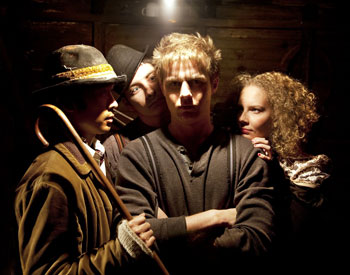
More like "Litmus Theatre's Matchbox Macbeth has murdered my barely-formed confidence in my theatrical talent", am I right?
Seriously though, it is equally intimidating and inspiring to witness true theatre at its best —and the recent remount of Matchbox Macbeth is exactly that. I am in absolute awe of every aspect of this production, and months later it is still a pleasure to speak about it!
Reworking the Bard
Shakespeare's Macbeth is 5 acts in length, with an approximate running time of 2.5 hours. Matchbox Macbeth is 1 hour long. Impossible, right? Gloriously wrong. They distilled each scene down to a few key lines without losing the tone or meaning, letting the actors' fantastic work and the audience's understanding fill in the rest. This was not your beginner's Shakespeare, but as long as you've read or seen it at least once, you were more than equipped to understand and appreciate this version.
Not Casting a Cat
Not Casting a Cat
Now on to casting. First of all, what the hell, Shakespeare? Six "WITCHES"? "A SPIRIT LIKE A CAT"?! That's just silly. I have seen Macbeth several times and I have never seen a Spirit Cat. Maybe I wasn't looking closely enough, but I'm pretty sure everyone else also thinks that Spirit Cat is superfluous. And how is Spirit Cat different from "Other SPIRITS"? Now I've typed "spirit" so much that it looks weird. Moving on.
Shakespeare's Macbeth has almost 30 characters. Matchbox Macbeth had 4 actors, one of whom only played Macbeth. The other three (one woman, two men) were then left to interpret all of the remaining characters, and they did an INCREDIBLE job. Lady Macbeth was suitably desperate and crazy without overacting. King Duncan's age and decrepit physical nature was evoked by having the actor walk with upside down milk crates attached to his feet. The ghosts were the perfect mix of malice and mischief. For clarity and timeliness many characters were omitted, but at no cost to the overall effect.
Shedding Tradition
Shedding Tradition
Now here's where it gets crazy. The staging was... It's been almost 10 weeks since I saw Matchbox Macbeth and I still don't think I have the right words to describe how incredible it was. To put it plainly, it was the best play I've ever seen AND IT WAS STAGED IN A FREAKING SHED. You know those sheds that all face into a communal alley, the ones that can barely fit one car? Yeah, one of those. THERE WAS A PLAY IN ONE OF THOSE! Amazing.
The audience was limited to 15 people, seated against the two side walls of the shed. Most of the action took place in the shed, with some moments happening through the back window (Lady Macbeth's death) or in the alleyway (a clever opening dumb show, entrances into Macbeth's "court"). Lighting was minimal --a few well-placed stage lights, tiny handheld flashlights, a few candles, and a very creepy red oven light-- but the dimness was an asset instead of a weakness. And the sound? Dear Lord, the sound. Taking full advantage of the shed, actors who weren't on stage would bang on the walls or whisper through cracks, creating an atmosphere of tension and darkness that is nearly impossible to have in a larger space. We felt claustrophobic and uneasy, and it was amazing.
Earned Praise
All of the actors were ridiculously talented and hardworking, and it showed. Way to earn your MFAs, guys! Seriously though, so much thought was put into making it an original production and taking full advantage of their limited resources. Nothing in the final product was superfluous or poorly planned. It ran like a well-oiled machine, but with enormous heart. Essentially, Matchbox Macbeth accomplished everything that I want to with my own production, overcoming every obstacle that I know I will also have to face. There's hope yet, if you are dedicated enough to the cause!
For a taste of the talent:
Links to other reviews of Litmus Theatre's 2011 remount of Matchbox Macbeth are below. A great little piece by one of the actors is here. Apparently their next project is a twisted version of Peter Pan! Let's all go together!
Earned Praise
All of the actors were ridiculously talented and hardworking, and it showed. Way to earn your MFAs, guys! Seriously though, so much thought was put into making it an original production and taking full advantage of their limited resources. Nothing in the final product was superfluous or poorly planned. It ran like a well-oiled machine, but with enormous heart. Essentially, Matchbox Macbeth accomplished everything that I want to with my own production, overcoming every obstacle that I know I will also have to face. There's hope yet, if you are dedicated enough to the cause!
For a taste of the talent:
Links to other reviews of Litmus Theatre's 2011 remount of Matchbox Macbeth are below. A great little piece by one of the actors is here. Apparently their next project is a twisted version of Peter Pan! Let's all go together!


